Ensuring basic medical care
Malnutrition and the communicable diseases that go with it, such as diarrhea, malaria, tuberculosis and respiratory infections are widely spread in many less developed regions. Since basic health care provisions in rural areas are usually very simple, and the local population as a rule has limited or no access to services, the mortality rate from such common, treatable illnesses is often extremely high. This problem of poor medical care is one that especially affects women and children.
To combat this issue, Malteser International is supporting around 220,000 people from the townships Maungdaw and Buthidaung, by strengthening and improving access to local basic health care structures and conducting awareness raising campaigns on health topics in communities.
Malteser International also runs primary health care clinics in cooperation with local health authorities, where patients receive basic curative and preventive care, and severely ill persons can be referred to public hospitals. A special focus is given to providing post and ante natal care to pregnant women and new mothers in these clinics.
The northern regions of Rakhine State lying on the frontier with Bangladesh are amongst the poorest regions in Myanmar. During the last years, the Ministry of Health and Sports has invested considerably in this remote border region to improve access to health care for all population. But due to its remoteness and the context, the area is still faced by challenges like recurring cyclones and floods, limited infrastructure, hard to reach areas, coverage of outreach work etc. Malteser International therefore supports the further improvement of the health sector in the field of control of communicable diseases – in particular tuberculosis and malaria. And to combat the incidence of diarrhea, caused by poor hygiene practices, and a lack of sanitation facilities - contributing to child mortality and aggravating acute and chronic malnutrition among children, which in turn leads to a higher rate of communicable disease amongst the malnourished population.
- Create access to decentralized, community based, basic health care services.
- Improve the capacity of health providers – both on a community level and at government health facilities.
- Improve the provision of drinking water and sanitation.
- Provision of basic health care in Malteser International run clinics and by supporting government health facilities.
- Training of Community Health Workers (CHW) and Traditional Birth Attendants (TBAs).
- Equipment of CHWs with urgently necessary medications and medical consumables.
- Equipment of TBAs with safe delivery kits.
- Training of government health staff and support of vaccination campaigns.
- Referral of seriously ill patients to hospital, and payment of the transport and treatment costs.
- Training and education program in villages and schools on the topics of hygiene, infant and childcare, malnutrition and infectious diseases.
- Provision of material and technical advice on the construction of household latrines.
- Strengthening of self-help capacity at the village level by training Village Health Committees and Mother Support Groups.
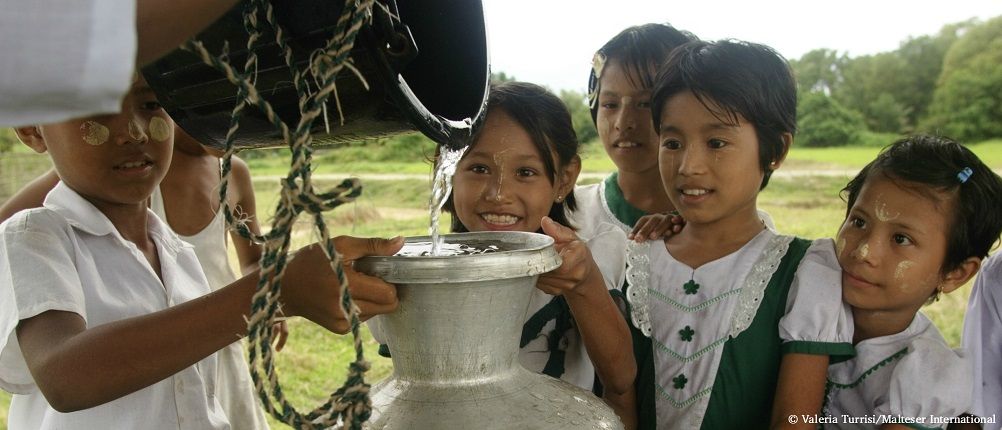
- Construction and rehabilitation of water supply systems accompanied by measures to ensure safe transport, storage and treatment of drinking water on the household level.
- Rehabilitation of sanitation facilities at supported government health facilities.
Country info
Capital: Naypyidaw
Area: 676,578 km²
Population: c. 51.5 Million
Project data
Project duration: since February 2004
Donors: UNHCR, Directorate General for Humanitarian Aid and Civil Protection (DG ECHO), EuropeAid, German Federal Foreign Office, Federal Ministry for Economic Cooperation and Development (BMZ), private donations
Last updated: August 2020