Strengthening Emergency Medical Services through scalable response technology
This project has ended in June 2025.
Emergency care is a vital component of resilient health systems – with prehospital care providing emergency call handling, dispatch, first response, on-scene treatment, and ambulance transport before patients reach a health facility. In low- and middle-income countries, where trauma, obstetric emergencies and other time-sensitive conditions cause substantial preventable mortality, effective prehospital care can significantly improve survival and reduce disability. However, limited ambulance coverage, weak communication systems, shortages of trained personnel, fragmented coordination, and inadequate financing continue to constrain service delivery. Strengthening prehospital emergency care is therefore increasingly recognized as a cost-effective strategy for improving access to life-saving interventions, strengthening referral systems, and advancing universal health coverage.
Malteser International is dedicated to enhancing emergency care systems in Uganda, Kenya, and Rwanda, while promoting equitable access to quality emergency healthcare for all populations. Since 2018, we have worked with respective Ministries of Health, training institutions, hospitals and professional organizations to shape emergency care policy, implementation, and practice.
Rescue.co is one of East Africa’s largest emergency response and rescue networks, providing members with rapid access to medical, security, roadside assistance, and air evacuation services through a 24/7 dispatch center. Their vision is accessible emergency response for everyone.
The Uganda Catholic Medical Bureau (UCMB) is the health arm of the Roman Catholic Church in Uganda, responsible for coordinating the Church's health services through a nationwide network of 33 hospitals, 264 lower-level health facilities, and 15 health training institutions. UCMB’s vision is a healthy and reconciled life for all individuals, their families, and their communities.
Uganda has made significant progress in strengthening its Emergency Medical Services (EMS). In 2021, the government launched the National EMS Policy, the National EMS Strategic Plan (2021–2025), and the Ambulance Norms and Standards, providing a framework for the development and regulation of EMS nationwide. More than 235 Type B ambulances have since been added to the national fleet, substantially expanding emergency transport capacity across the country. The government has also established two ambulance dispatch centers, established a single national number for emergencies (912) and plans to further strengthen coordination by expanding the network to 16 regional dispatch centers.
Despite recent progress, Uganda's emergency medical services continue to face significant operational and financial constraints. Ambulance dispatch remains largely manual, with limited real-time coordination, fragmented private providers, and inadequate ambulance capability, resulting in delayed response times and inefficient access to appropriate care. Financial sustainability is further undermined by low insurance penetration, the absence of a national health insurance scheme, and high out-of-pocket expenditure, which accounts for 38.3% of total health spending. Addressing these coordination, quality, and financing challenges is essential to developing an effective, equitable, and sustainable national EMS system.
Our goal is to strengthen emergency medical services through an operational and scalable emergency response tech infrastructure and ambulance dispatch service launched in Uganda through rescue.co across the UCMB network. This would be achieved through the following subgoals:
- Build capacity of ambulance response teams
- Improve ambulance readiness and quality of ambulances
- Digitize and integrate ambulance dispatch and referral systems
- Operationalize coordinated ambulance dispatch and referral services
A mapping exercise was conducted across the 305 health facilities in the UCMB network to assess emergency care service level capability.
Four priority regions were selected for implementation: Greater Kampala Metropolitan Area (GKMA), Gulu, Kabale, and Mbarara covering 19 districts, and 50 UCMB health facilities. The regions were prioritized because they had a significant pool of existing Type B ambulances. When complemented by additional ambulance upgrades, these ambulances would enhance the capacity of strategically located hospitals and ambulance hubs to provide effective emergency referral coverage across underserved, remote, and high-referral areas within the UCMB network.
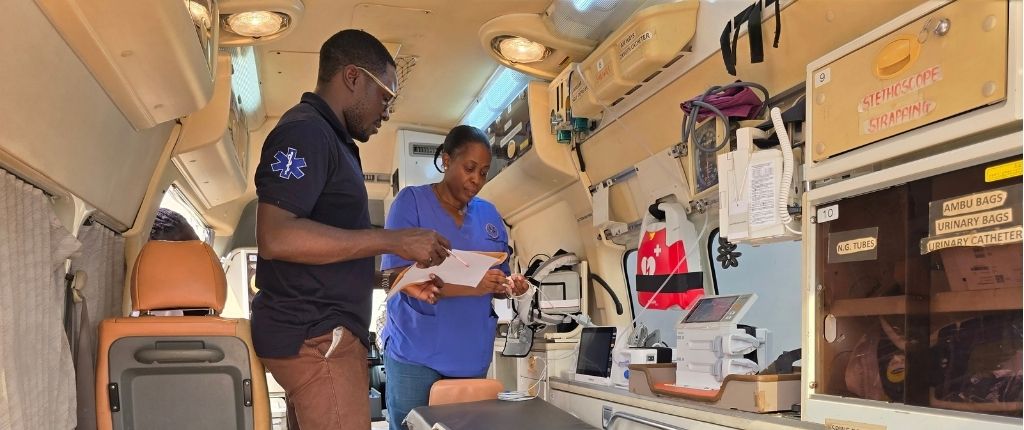
08 ambulances were upgraded to complement existing capacity and thereby improve emergency care during patient referral in the target regions. The upgrades included:
6 Type A (patient transport vehicle) to Type B (Basic Life Support) at Lacor hospital Kalongo hospital, Nkozi hospital, Nyakibale hospital and Naggalama hospital
2 Type B to Type C (Advanced Life Support) at Lubaga hospital and Nsambya hospital
100 staff from across the 4 target regions were training in prehospital care:
35 ambulance drivers trained in First Aid
53 nurses, 12 midwives and 06 other cadres trained in Basic Life Support
Over 2,500 ambulance transfers for emergency conditions were coordinated via the new digital dispatch system across the 4 health regions and using over 22 ambulances, over a 1-year period.
Project data
Donor: KfW DEG
Partners: rescue.co & Uganda Catholic Medical Bureau (UCMB)