Dancing was Ahmed’s passion
Medical assistance for people from Gaza
Ahmed proudly shows the videos his father recorded on his phone of his performances. Some videos of him and his dance group were also posted on YouTube. That was before a bullet struck the 21-year-old in the head. At the time, he was out on the streets of Gaza looking for food. His family’s home had been completely destroyed by a bomb, leaving them homeless. Hardly any aid deliveries were being allowed into Gaza at the time, and many families were going hungry. The bullet to Ahmed’s head shattered his dream of dancing on stages in Gaza.
The bullet hit areas of his brain responsible for movement and speech. Ahmed has been using a wheelchair ever since. The gunshot wound to his head became infected, and the bullet is still lodged in the back of his head, in a location where surgery would be too dangerous. He has repeatedly taken antibiotics, but the wound has still not healed. He cannot move his right arm or right leg. Speaking, as well, is difficult for him.
Since 11 October 2026, a team of volunteer German doctors, a psychologist and a nurse has been working for Malteser International in Cairo, treating children and adults like Ahmed who were injured during the war in Gaza. The injured were evacuated from Gaza to Egypt, but the healthcare system there is overwhelmed. Hospitals have hardly any capacity to provide medical care for the thousands of children and adults that have arrived from Gaza since the ceasefire.
All the patients who have been evacuated have serious injuries
“The patients who were evacuated from Gaza to Cairo all have severe injuries, such as burns, amputated limbs, or bomb fragments lodged in their heads or backs. These persons in particular depend on specialist medical treatment. Almost all of them are traumatized. They have not only lost their homes but, in most cases, family members as well,” says Lihic.
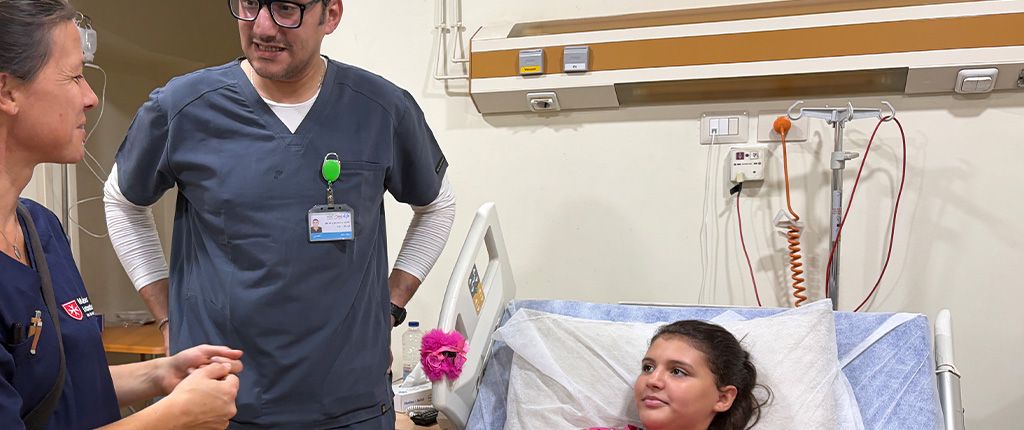
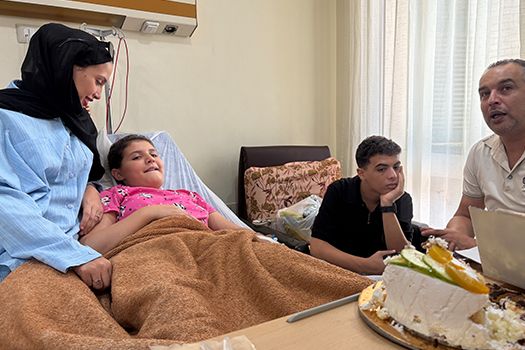
One of them is Aleen. Shortly after the war began, her home was bombed. While she suffered severe burns, rescue workers spent hours searching through the rubble for her father, Mohammed Al gha Layeng. During the search, Aleen learned that her mother and two of her four siblings had not survived the attack. Aleen sustained severe burns to her left leg. Jan Wynands, a plastic surgeon volunteering with Malteser International, smoothed the scar tissue again so that Aleen could move her leg more easily. Just one day after her operation, she is already visibly better. Her entire remaining family has gathered in her room at the Umberto I Italian Hospital. It would have been her older sister’s birthday.
Comprehensive patient care
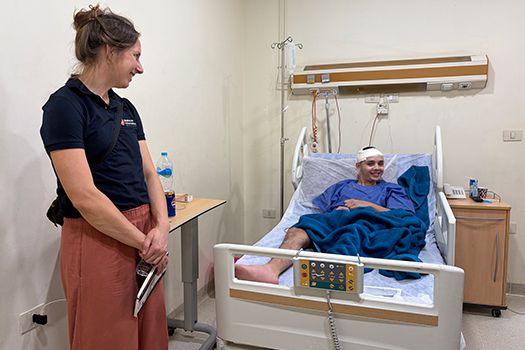
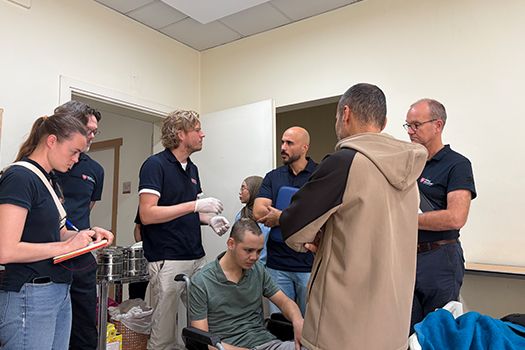
Ahmed also had to undergo surgery so that a deeper sample could be taken from the wound to determine the best way to treat the infection. One week after the operation, he is treated by Hamburg-based orthopedic surgeon Christoph Weinhardt. “What matters now is helping Ahmed become more mobile again and begin strengthening his right arm and leg as soon as possible. The goal is for Ahmed to learn to stand and walk again, at least with the right assistive devices, and thereby regain a degree of independence,” says Weinhardt.
“It is important to us to provide patients with comprehensive healthcare. That is why our team also includes a psychologist who can conduct an initial consultation and then assess how we can offer further psychological support,” says Edo Lihic, Malteser International’s Field Coordinatorr.
Psychologist Henriette Hermühlen also spoke with every patient who wished to do so. “The first question I always ask everyone is: Who are you here with? Because that is the most important resource they still have: people who look after them. What I find unimaginable is that, after everything they have experienced, they are still mentally present – able to speak with me and tell me about their experiences. I find that incredibly impressive, and it demonstrates tremendous resilience,” says Hermühlen.
Every story deserves to be heard
Ahmed’s father, Iyad Abu Al-Khair, says: “Ahmed’s story is not only the story of a severe injury. It is the story of a young man and his family whose lives have been torn apart by war. Behind every injury and every destroyed home is a person and a family whose suffering deserves to be heard.”
The two-week deployment of volunteer professionals in Cairo was initially a pilot project. “We would like to return at regular intervals and continue treating people from Gaza, because the need is great. But whether we will have the financial resources to do so, remains to be seen,” says Lihic.